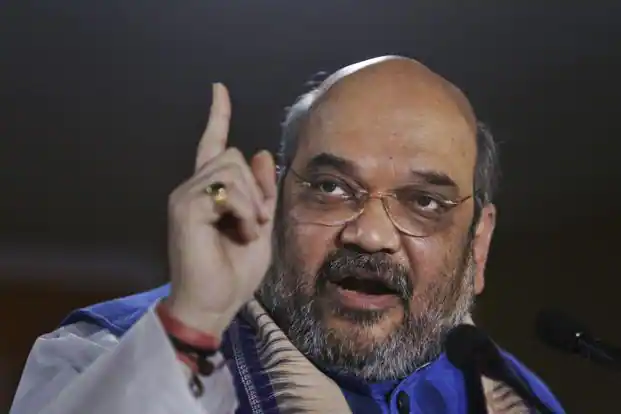
The BJP is readying for Delhi assembly elections and once again, an astute Amit Shah showed his hand by inducting Kiran Bedi into the party.
Live Mint
While the BJP president is admired by party workers for his ability to deliver, the bouquets have not come without their share of brickbats
The Bharatiya Janata Party (BJP) is on a roll. After a splendid run in 2014, where it stormed to power at the centre, the party won assembly elections in states as diverse as Jharkhand, Maharashtra and Haryana, even as it emerged a formidable force in Jammu and Kashmir and will play a decisive role in government formation there. While Prime Minister Narendra Modi, with his charisma, energy and vision, has been the face of the campaign, it is BJP president Amit Shah who has been the architect of the party’s victories with his eye for detail, emphasis on booth management and grasp over grassroot-level electoral permutations and combinations.
The BJP is now readying for the assembly election in Delhi and once again, an astute Shah showed his hand by inducting former Indian Police Service (IPS) officer Kiran Bedi into the party and making her the chief ministerial candidate. Given Bedi’s image as a no-nonsense, tough and upright officer, she is expected to appeal to the middle and lower-middle class and pose a tough challenge to the Aam Aadmi Party (AAP).
While Shah is admired by party workers for his ability to deliver, the bouquets have not come without their share of brickbats. In the last eight months of the National Democratic Alliance’s (NDA) rule, Shah has been repeatedly attacked by his political opponents. He is a convenient target. So, whether it’s the controversial Ghar wapsi (reconversion) programme sponsored by fringe Hindu organizations or avoidable outbursts by some of the party’s leaders in Uttar Pradesh, adversaries have been quick to link them to Shah. The fact that the Modi-Shah duo have disturbed the status quo in the power equations in Lutyens Delhi has only sharpened the criticism.
The BJP and Shah have been quick to distance the party from some of the comments attributed to the party’s MPs.
The party has told its leaders not to speak out of turn. At one level, Shah is the party’s president and the buck stops with him. At another, it does seem a bit unfair to target him every time a BJP leader says something outrageous. Leaders such as Sadhvi Niranjan Jyoti (who hurled obscenities at people who didn’t support her party), Sakshi Maharaj (who praised Mahatma Gandhi’s assassin Nathuram Godse and then said Hindus must have four children), and Yogi Adityanath (the party’s emerging face in Uttar Pradesh) have all been with the BJP for some time and have not been suddenly promoted by Shah for electoral gains.
There is a larger issue of decency in political discourse and all parties have been at fault here. Modi himself has been at the receiving end of some such comments in the past although these instances didn’t get as much traction as the inflammatory comments of people such as Jyoti and Maharaj.
Similarly, in a context where religious conversions have been happening unchecked in India for decades (Hindus were forcibly converted to Islam till a few centuries ago and Christian missionaries continue to lure tribals to their faith with assorted incentives), an obscure reconversion programme organized by a fringe group in Agra hit the headlines. The debate over Agra died down only after Shah and several other BJP leaders said they were all for a law banning all religious conversion in the country.
Many regional parties are upset with Shah over his visits to states such as West Bengal, Odisha, Andhra Pradesh and Kerala. Shah, as party president, wants to strengthen the BJP in areas where it has traditionally been weak and his efforts shouldn’t be seen as an attempt to undermine the regional parties, including those who have done business with the party in the past. Some of these efforts would appear to be paying off. For instance, the BJP’s student wing won 14 of 16 posts in elections at the College of Jute Technology, University of Kolkata.
The Congress is rapidly ceding ground across the country and it is only natural that the BJP, which is on the ascent, is looking to replace it as a truly national party. While the BJP currently doesn’t enjoy a majority in Rajya Sabha and that does hurt legislative business,, it doesn’t mean that the party should play second fiddle to regional satraps and suspend its plans to expand its electoral presence. A country of India’s size and the scale does need a strong national party. This is essential for a federal structure. I believe the BJP fits the bill. Moreover, it is, going by experience, not necessary that the parties opposed in state politics will also oppose each other in Parliament. The Congress and Samajwadi Party are opposed to each other in Uttar Pradesh but usually on the same side in Delhi.
Finally, Shah has also been accused of influencing a Central Bureau of Investigation (CBI) court in his favour.
On 30 December, a special CBI court gave its verdict in the much publicised Sohrabuddin Sheikh and Tulsiram Prajapati fake encounter cases and dropped all charges against Shah. The Sohrabuddin and Prajapati cases were clubbed and transferred from an Ahmedabad court to the Mumbai court in 2012 following a Supreme Court order. The court also came down heavily on the CBI for relying on hearsay evidence. While Shah is accused of influencing the judgment, it must be pointed out that CBI had completed its investigation in the fake encounter case during UPA’s regime. “I found substance in the main contention of the defence that the accused is apparently shown to be involved in this case by CBI for political reasons,” the judge said.
It is time to start engaging on issues that are critical for the country’s growth and prosperity. Questions must be raised and constructive criticism must be offered. There should be a debate on the performance of the eight-month-old Modi government, but based on facts. A number of key measures have already been taken in this short period and hopefully, these will come together to produce results for the nation in the near future. To my mind, too much noise around issues such as reconversion takes the focus away from the core issue of governance. Nor should the opposition see everything as a devious plan by Modi and Shah.
The focus of everyone, including the opposition parties, has to be on progress and prosperity.
Devendra Kumar is a psephologist and director of the Research and Development Initiative.
Rean on the Live Mint: Click Here